

Larry Johnson knows something is not right with him.
The 46-year-old former All-Pro NFL running back has had no shortage of indicators. He points to his moments of disorientation, when he doesn't know where he is, or when he doesn't remember putting an item in his pocket minutes before. He's also reminded when he struggles to control his emotions.
"My short-term memory was so bad, I could literally go into a store and 30 minutes later come out and not know where my car is parked," Johnson said. "Or, I'm driving and I just get blanked and I don't even know where I'm going or know where I'm at."
Johnson, a 2003 first-round pick by the Kansas City Chiefs, is convinced he has chronic traumatic encephalopathy, the progressive, degenerative brain disease known as CTE. It's a product, he believes, of the constant pounding he took during nine seasons as one of the NFL's most physical backs. Researchers believe CTE is caused by repeated sub-concussive hits to the head.
But Johnson doesn't know for sure if he has the condition.
He can't.
Currently, scientists can only diagnose CTE by studying a brain after death, leading many former NFL players to commit their brains to science after they die.
But what if CTE could be diagnosed in the living?
"I think we're close," said Michael Alosco, a neuropsychologist and associate professor at Boston University. Alosco is part of a team conducting government-funded research in this area through the second phase of the Diagnose CTE Research Project. Alosco said subjects in his study are 50 and older because that's when CTE is generally thought to be developed enough to be captured with testing.
Researchers have been following over 300 former players -- in addition to Alzheimer's patients who did not play the sport -- since its first phase began in 2015. Now they're looking for patterns to emerge in testing. Putting an exact timeline on these efforts is difficult.
Clarity from such a test might inform how doctors treat current or former players experiencing symptoms associated with CTE. Definitively diagnosing or ruling out CTE could be a game changer for those who assume they have the disease but don't.
"Many of these conditions cause cognitive symptoms that may overlap with CTE, but the difference here is that they are treatable," said Rachel Grashow, a researcher at Harvard University who has studied the health of former NFL players.
"And ignoring this reality has dire consequences. We know that having cognitive symptoms and these conditions puts players at a much higher risk for believing they have CTE, and at risk for frequent thoughts of self-harm."
A study published in 2024 reported nearly a third of former NFL players with general health symptoms -- including sleep apnea, hypertension, low testosterone and depression -- believed they had CTE. That group was five times more likely to have suicidal thoughts than those who did not attribute their symptoms to CTE.
ESPN asked more than 30 active and retired players this summer about a range of CTE-related topics, including whether they would take a test if it could diagnose CTE while they're alive, and how that would impact whether they would continue playing.
Would you take the CTE test if one were available?
Marcus Mariota, Washington Commanders QB, 32, in his 12th season: Yeah, I would. I think because at the end of the day, it gives insight to the rest of the NFL, to college kids, to high school kids of what we're getting ourselves into. Then yeah, absolutely.
And I hope as we get going further into this that there are people that are open to be studied and hopefully you can kind of get answers a little more available and give guys kind of a clearer picture of what this all looks like.
CJ Williams, Jacksonville Jaguars WR, 23, in his first season: I would probably take it post-football. And it would probably be because I love the game so much. I wouldn't quit football knowing it. It'd be a very hard quit for me. But after I'm done playing, I would probably do it because I would make lifestyle changes for that reason.
Joshua Metellus, Minnesota Vikings safety, 28, in his seventh season: I probably wouldn't want [the test] while I'm in the league, because I think it'll change the way I play. But I know there's a lot of guys who are very curious and would like to know.
And it would change the way to play ... more safe, play more conscious of it. Or not play.
DeShon Elliott, Pittsburgh Steelers safety, 29, in his eighth season: Yeah, I would. I definitely would. Because I would like to know, and then I can figure out how I could prevent it.
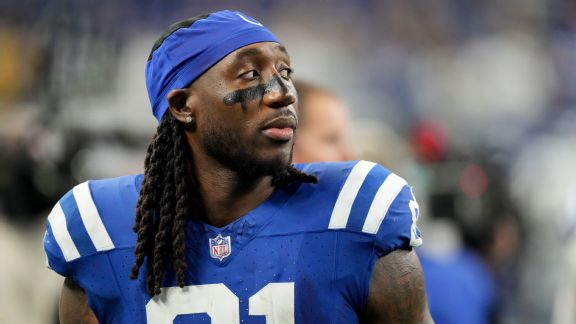
Mo Alie-Cox, Indianapolis Colts TE, 32, in his ninth season: I don't think I would want to know, because then people will start treating you differently, looking at you differently.
When people get diagnosed with something, people start trying to baby you and things like that. I don't think I would want to know. But I think if symptoms start to show, then of course I would, just to protect you and everyone else around you. You can treat it if they end up finding a treatment for it. But right now there ain't no treatment and no one knows how to diagnose it. So it's a very complex situation you're dealing with.
JJ Jansen, Carolina Panthers LS, 40, in his 19th season: If there was sort of a noninvasive way to understand where you stood on your health, I think anyone would do that, right? We're already doing that with blood testing, urine tests. We have one of the most extensive preseason physicals in terms of testing our bodies of probably any league currently, which is obviously a fantastic thing. So I think anyone would at least be willing to consider adding that into their planning purposes.
Micah McFadden, New York Giants LB, 26, in his fifth season: I probably would, yeah. Yeah. I'd be interested in that.
Will Fries, Vikings guard, 28, in his sixth season: Oh wow. That is a really good question. I don't know. I don't know what I would do, honestly. Wow. Stumper. I think for me, I'm playing this game because one, I'm very fortunate to be able to play it. I'm really lucky I've worked my whole life to be in this situation and I'm just going to maximize the resources that I have of brain health and prevention.
Robert Hainsey, Jaguars C, 28, in his sixth season: Yeah, for sure.
Malik Hooker, Dallas Cowboys safety, 30, in his 10th season: Absolutely. I mean, not only for me but my family as well. I feel like they've sacrificed so much as far as their time, their responsibilities and their lives into helping me and supporting me for my job, the least I could do was make sure I'm up to par as far as my health, my mindset and my mentals.
Would you keep playing if tests showed you had CTE?
Green Bay Packers safety Xavier McKinney, 28, in his seventh year: Probably not. No.
Hainsey: Tough question. Too many variables there, because I don't know how good the test is if they just come out with it. ... If they come up with it now, we're the guinea pigs. We don't freaking know if it's going to work or not. So, I couldn't say. If you knew for sure [if it was accurate], yeah, you'd have to think about it because we got a lot more years to live after football, for sure. But that's a tough one because it's just too hypothetical.
Jansen: Certainly, if you had information that said you were more susceptible or you were maybe already dealing with stuff, I think guys would feel differently about it. That being said, like you're dealing with a lot of unknowns. And as the science continues to develop and we're learning more about the brain and all of these things, I think guys are making more educated decisions.
"I don't think I would want to know, because then people will start treating you differently, looking at you differently." Mo Alie-Cox on whether he would take a CTE test if it could be diagnosed in the living
Hooker: That would be a discussion I would have to have with my family, obviously the professionals and try to make the best decision not only for myself but my family as well.
Some players spoke with ESPN only on the condition of anonymity.
An NFC linebacker: I don't think that would change anything for me. To me right now, I don't think there's enough data.
An NFC offensive lineman: Oh my gosh. I don't know. That's a hard question. I've never thought about that. No, I don't think so. That's a hard decision. Right now I'd say no. That's probably something I'll go back and ask a lot of the guys, too, because that's a really good question.
An AFC linebacker: With me, for my love of the game, if I feel like I'm OK, I would play through it. But if I went and got tested and the situation was more severe than what (was previously believed), then I would have to think about it.
An AFC defensive back: I think that would be a question I would have to talk to my family about. But me personally, the competitor in me, I'm not going to stop. If it's there already, it's not going to get too much worse. But it'll probably have to be a conversation.
An AFC offensive lineman: I think I'd have to know more of the studies of how it would affect me long-term.
Contributing: Todd Archer, Ben Baby, Sarah Barshop, DJ Bien-Aime, Rich Cimini, Courtney Cronin, Rob Demovsky, Mike DiRocco, Mike Kaye, John Keim, Jeff Legwold, Brooke Pryor, Katherine Terrell, Stephen Holder, Jordan Raanan, Kevin Seifert, Josh Weinfuss, Eric Woodyard